Importing documents
| The documents uploaded to G-nom are available to all users of the G-nom instance. Therefore, your uploads must always comply with copyright and data governance regulations of your organization. |
In addition to genomic research data, G-nom supports the import of arbitrary research documents. The most common use case is papers related to the project using a specific G-nom instance. Documents are uploaded into G-nom in .pdf format and stored alongside the genomic research data.
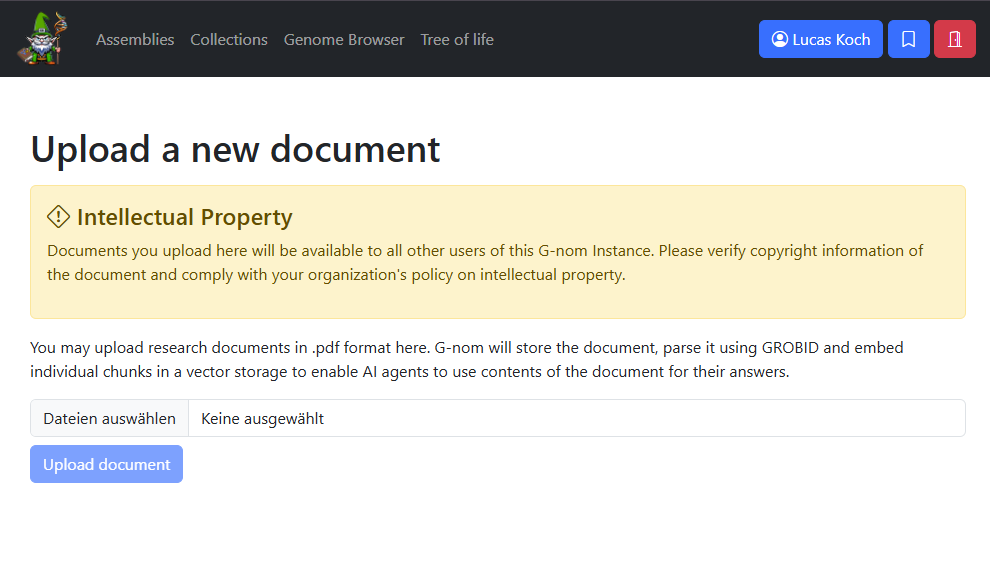
During the import, G-nom converts the documents to TEI using GROBID. The TEI data is then used to extract key information such as title, abstract, authors, DOI and references from the document. A database record for the document is created in the G-nom database. The main text of the document is broken down into chunks of text and an embedding model is used to store them in a vector storage. The vector storage allows both users and AI agents to utilize semantic search to retrieve documents of interest.